What Turns a Gold Token Into a Fund
In May the Financial Conduct Authority and the Bank of England asked the market what it wanted from tokenization in UK wholesale finance. By September they had 123 responses.

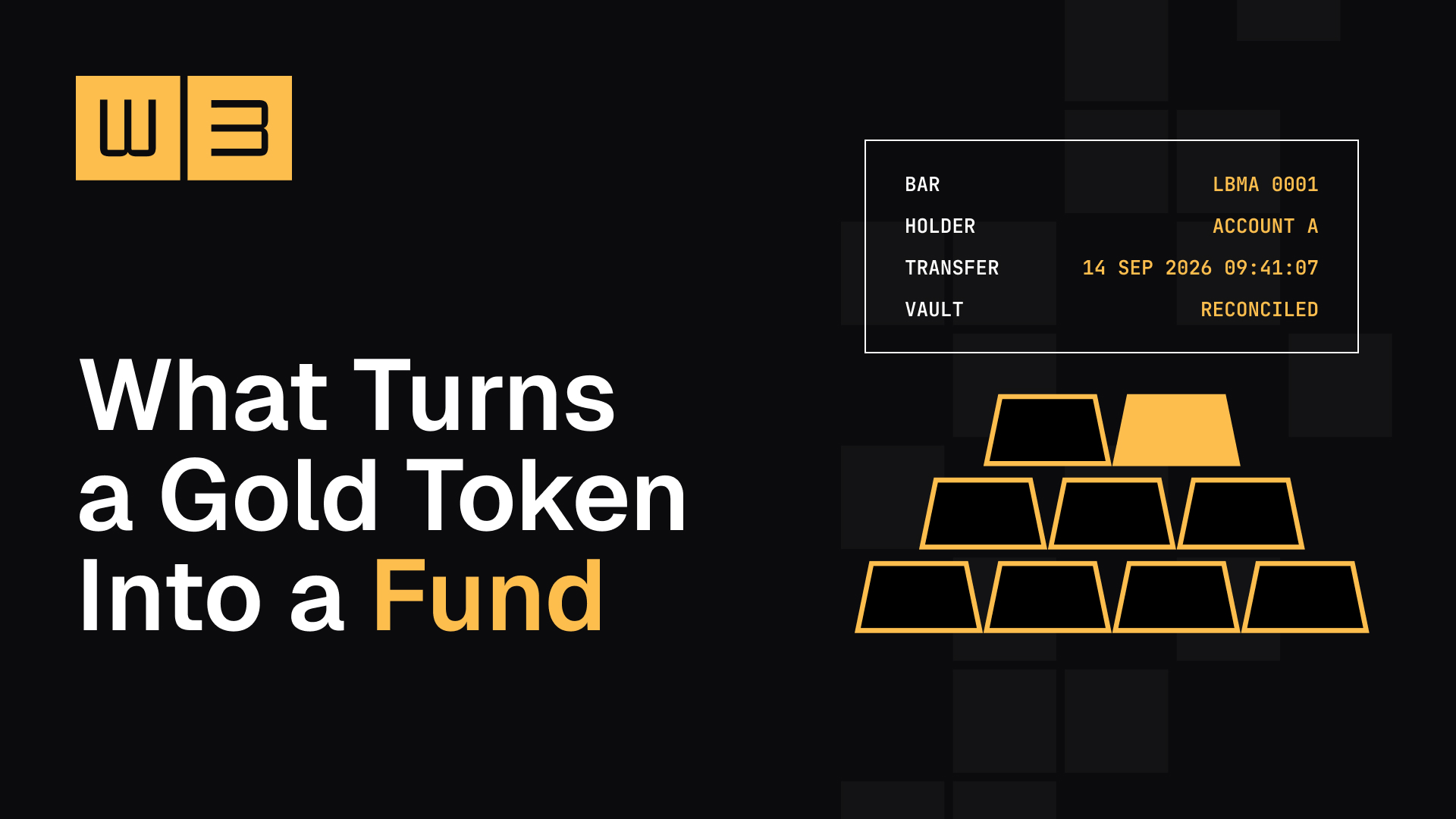
In May the Financial Conduct Authority and the Bank of England asked the market what it wanted from tokenization in UK wholesale finance. By September they had 123 responses. Collateral came up more than any other use case, and several respondents raised gold, on the strength of London's spot market. On September 14 the FCA published a separate call for input on tokenized gold. Responses are due October 23, and a tokenization roadmap with dates for each workstream follows later this year.
The gold paper is fourteen pages, and most of it describes what tokenization could do for a market that already works. The part that will decide whether any of it happens is a question about classification. Under UK rules, some gold tokens may be collective investment schemes or alternative investment funds, while others may not. For a third group, the FCA says the analysis may not be conclusive.
Which category a token falls into depends on what its record of ownership shows.
London's gold settles on two systems
The London over-the-counter market is the largest spot gold market in the world, roughly 70% of global notional trading by the World Gold Council's estimate. It runs on 400-ounce Good Delivery bars, vaults operated by clearing members and the Bank of England, and a chain of custody the Council describes as strictly enforced. The FCA says it has no intention of regulating the parts of that market outside its perimeter.
The regulator describes the structural limits. Allocated gold gives an owner certainty, because the custodian records specific bars as belonging to a specific account holder, and it is slow and costly to mobilize. Unallocated gold moves easily through account-based transfers, and it is a claim on the account provider, which makes it less suitable as collateral. On top of that, the metal leg and the cash leg of an OTC gold trade settle through separate systems. The paper names the consequence as timing, reconciliation, and operational risk.
So the strongest form of ownership is the hardest to move, and the easiest form to move is a counterparty exposure. Tokenization is under discussion because it might give allocated ownership the mobility of an unallocated account.
Classification depends on the record
The collective investment scheme definition in UK law is broad. It can cover property of any kind, and a gold token qualifies if it satisfies three statutory limbs. The alternative investment fund definition overlaps with it. A UCITS scheme cannot be dedicated to gold, so a gold scheme that meets the definition is likely an unregulated one, which limits who can be offered it.
The FCA then sets out the distinction. A token that directly represents ownership of an allocated bar that can be commercially traded is more likely to sit outside both definitions. Each holder owns a specific allocated interest, and nothing is pooled or managed as a whole. A token that represents a fractional interest in a single bar that is managed or disposed of collectively looks like pooling, and pooling is what the definitions cover. Industry groups have proposed co-ownership structures they argue fall outside the perimeter, and the FCA says it is open to hearing why those structures would not still meet every element of the definitions.
The difference between a commodity and a fund, on the FCA's own account, is whether the record shows which bar, which holder, and who can dispose of it. The classification follows from what the record captures. The paper adds that uncertainty on this point may restrict who is willing or able to hold a token at all, and that a token's prudential treatment and its use as collateral may differ depending on whether it is classified as gold or as a fund unit.
Collateral moves faster than a vault reconciles
Collateral is why the regulator is looking at this. In the May responses, collateral was the most frequently mentioned use case by a wide margin, ahead of round-the-clock trading and atomic settlement, which respondents rarely raised except where they touched collateral. Firms wanted to know when tokenized money market funds, gold, and stablecoins would count as eligible collateral. One US study cited in the feedback found market participants holding 7% more collateral than required, as a buffer.
Gold is a candidate because institutions already hold it and largely cannot pledge it quickly. The FCA's list of wholesale uses runs through securities lending, repo, and derivatives, with intraday mobility as the goal, and it describes a delivery-versus-payment exchange of a gold token against a dollar token, which would settle both legs in one step.
Margin sets the timing requirement. Respondents told the regulators that better transparency could allow real-time margin calculations and that round-the-clock trading could support out-of-hours margin calls. The gold paper notes that tokenized gold products have been driving weekend price discovery because they trade through the weekend. A margin call issued automatically on a Saturday night and met with a gold token needs a record that shows, at that moment, which bar backs the token and who holds the claim. A vault reconciliation run at the end of the next business day describes a position that has already changed.
That is the same condition W3.io builds for in other markets. When capital moves on an automated instruction, the record of what moved has to be created by the transfer itself and be readable by every party to it, so a treasurer or a secured party can verify a position as it changes hands.
Twelve conditions, and most of them describe a record
The FCA says a wider exemption from fund rules would have to be limited to products regulated under a different regime with protections at least as effective. It then lists twelve things that regime would need to address.
Some apply to any gold product: the quality of the metal, the price benchmark, financial crime controls, orderly wind-down. The rest describe a record. The legal nature of the holder's interest. Custody, vaulting, and segregation. Issuance and redemption, including reconciliation between physical and on-chain records. Independent audit, including of custody records and the reconciliation methodology. Governance and accountability, including oversight of outsourcing and third parties. Disclosure of custody arrangements and redemption rights.
The wholesale section raises the same questions for collateral use. Whether a holder's rights in the bar are enforceable. How the token is treated in insolvency. Whether a secured party can take control of it and realize it. When settlement is final if the transfer happens on a ledger. How the token record is reconciled with the custody and vault records.
A regulator has written down, in a public document with a response deadline, what a record of ownership in a physical asset has to be able to prove for that asset to sit outside fund rules.
Answering the FCA means describing the record
Question three of the paper asks whether a defined set of gold token arrangements should sit outside the fund regime, and if so, what conditions should set the scope. Any firm that answers it will be describing a record: what each holder owns, whether the bar is identified, who can move the token and under what conditions, and how the token position and the vault position are shown to agree, and by whom.
A token whose record cannot answer those questions reads as pooled property. Pooled property, on the FCA's description, reads as a fund, whatever the issuer intended. A token whose record can answer them is what the paper says it wants, gold with clear ownership rights and reliable redemption that can be pledged and moved without becoming a claim on an account provider.
The FCA has said it expects the infrastructure to be industry-led. Firms that hold gold as collateral, or want to, have until October 23 to say what they need the record to prove.