The Approval Moves the Money
Corporate treasurers want cash that moves when the business does. In the 2026 AFP Liquidity Survey, 41% of respondents said they expect money market funds to offer 24/7 access. Bank deposits now hold 42% of short-term investments, the smallest share since 2011.

Corporate treasurers want cash that moves when the business does. In the 2026 AFP Liquidity Survey, 41% of respondents said they expect money market funds to offer 24/7 access. Bank deposits now hold 42% of short-term investments, the smallest share since 2011.
The products that already run around the clock have barely registered with treasury teams. Only 1% of organizations are piloting or using stablecoins and tokenized products. Another 9% are exploring them.
The AFP points to pending regulation as one reason. Another sits inside the company. Every move of treasury cash has to clear an approval chain built for bank rails, and an option that can't clear the company's own approvals never gets used.
When the signer's approval is the step that settles the trade, that holdup goes away.
Treasury uses what the policy allows
Three in four organizations in the survey have a written investment policy for short-term cash. It names the permitted instruments and the people who can approve a move, and an auditor or board committee will eventually ask to see both. A new instrument earns a place only after it fits that policy and the approval chain the policy describes.
That gives a treasurer a practical test for any 24/7 product. Can the approvals the policy requires run inside it, at the hour the money needs to move? If approvals still live in email while settlement runs around the clock, the product inherits the bank's hours anyway.
The approval step exists for good reason. The AFP's 2026 Payments Fraud and Control Survey found that 76% of U.S. organizations faced attempted or actual payments fraud in 2025, and business email compromise affected 74%. Those schemes work by getting one person to act on one message, so the defense is a separate check before money moves. That check matters more as software, including AI agents, takes on the drafting. An agent can prepare an allocation in seconds. The approval is where a person with authority decides whether it happens.
The sequence in practice
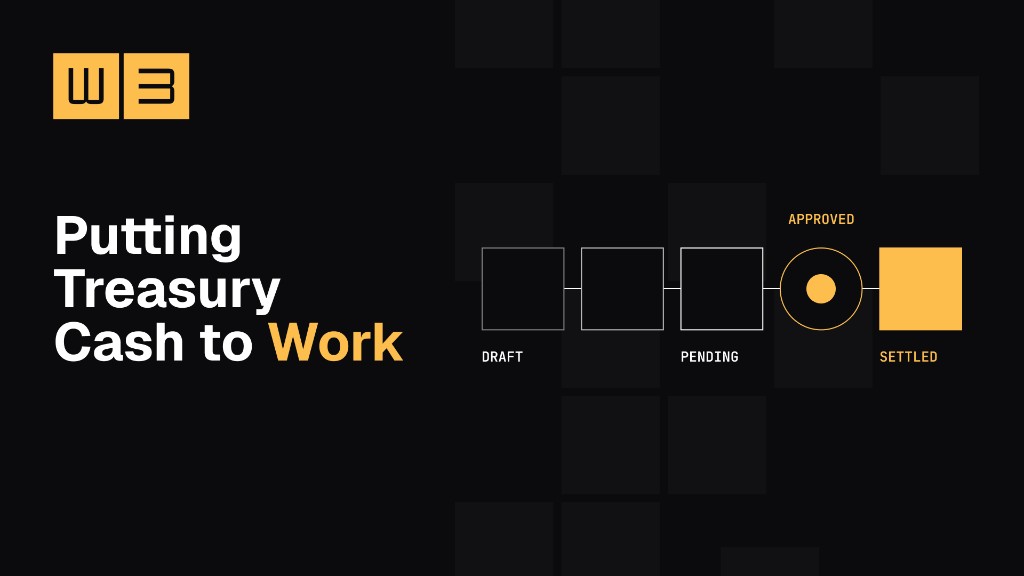
A treasurer swaps operating dollars into a dollar stablecoin, then submits an allocation from that balance to an on-chain yield vault. The vault takes deposits in the same transaction, so there is no fund subscription cutoff to wait for. The allocation sits in the approvals queue as pending until the designated signer approves it, and then it settles.
Bank rails keep two records, on-chain keeps one
On bank rails, approval and settlement happen in different systems at different times. The approval lives in a treasury portal or an email thread. The payment settles later, on the bank's schedule and the payment system's operating hours. A purchase approved late on a Friday can wait until Monday, and someone matches the approval to the bank confirmation the following week. Until then, the approval and the payment are two separate claims about the same money, and they can drift apart.
On-chain, the two can be the same transaction. A treasury balance held in a multi-signature account can only move when the required signers sign. The final approval is the signature that sends the transaction, and the transaction carries the record of who approved it and when. The signatures cover the exact amount and destination. If either changes, the signatures no longer match and the transaction does not execute.
W3.io builds agent-powered financial workflows on this, so the authorized signer's approval is the step that releases the money.
For a treasurer, that changes what it takes to answer the auditor at quarter end. "Who authorized this move?" used to mean pulling a portal log and lining it up with a bank statement. When approval and settlement are one transaction, the answer is already written into the payment.