The Statement Arrives After the Money
For most of the history of wealth management, the advisor could do more with a client's money than the client could. The assets sat with a custodian the firm chose, trades went through a desk the firm controlled, and a client who wanted to move a large sum made a call, signed something and waited for the firm to act on it. The client's reach ended at the phone.

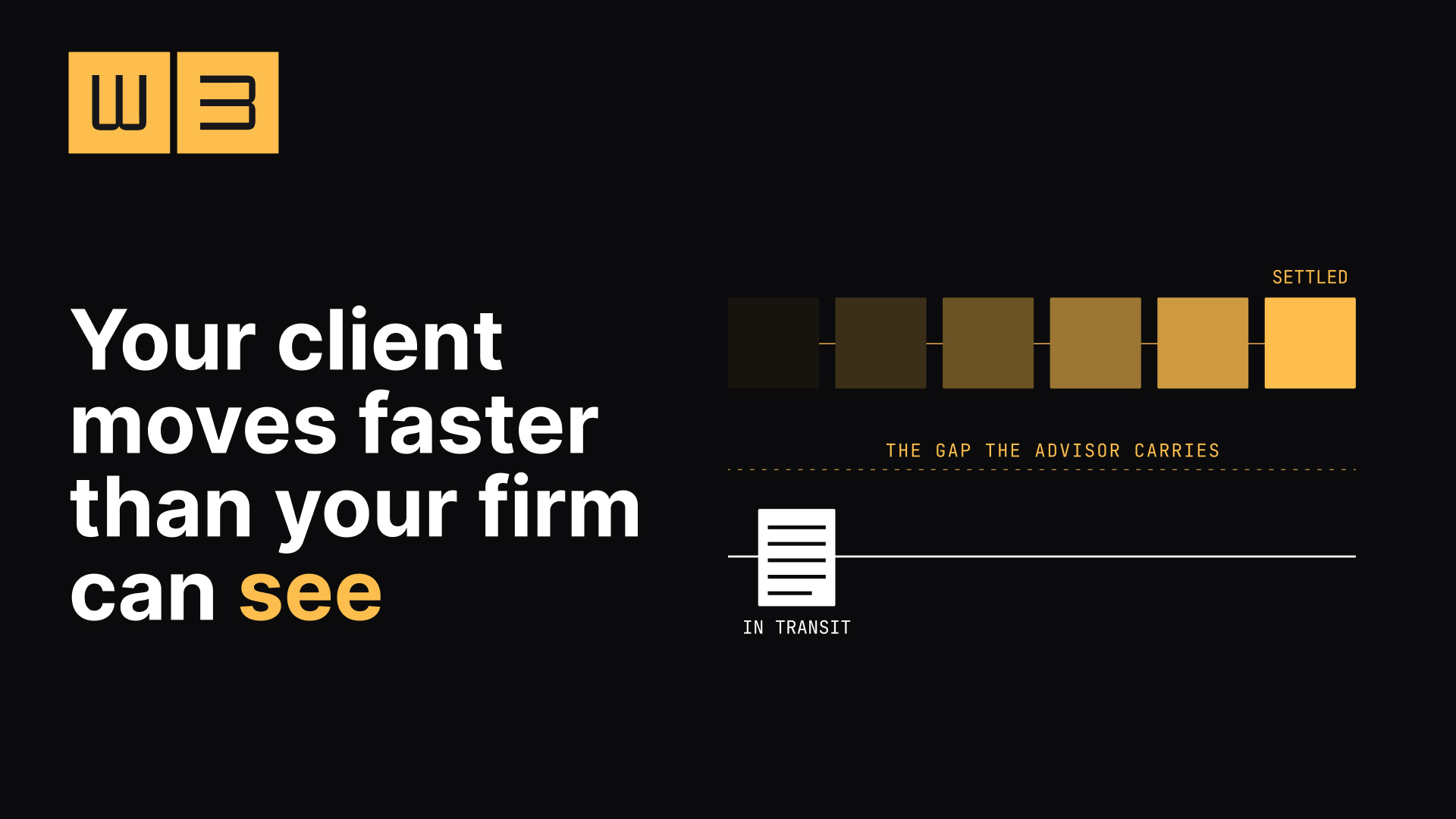
For most of the history of wealth management, the advisor could do more with a client's money than the client could. The assets sat with a custodian the firm chose, trades went through a desk the firm controlled, and a client who wanted to move a large sum made a call, signed something and waited for the firm to act on it. The client's reach ended at the phone.
Digital assets reversed that. A client with an exchange login or a wallet app can move any amount at any hour without anything in the firm's stack registering it, and the advisor learns about it when the statement arrives, if the statement includes it at all.
The duty didn't reverse with it. The advisor is still the fiduciary and still the person the family calls when something goes wrong. What moved was the client's operational reach. Accountability stayed where it was.
Three in four advisers have clients holding assets they can't see
The numbers are public, and they're moving the wrong way for the firm. In the Bitwise/VettaFi survey of 299 U.S. advisors fielded in late 2025, 74% said some or all of their clients hold crypto outside the advisory relationship, up from 71% the year before and 59% two years before that. The same survey found 58% of advisors either can't buy crypto in client accounts or don't know whether they can, and 48% named home office restrictions as an obstacle.
Those two figures describe the same clients from opposite sides. The client is already in. In most cases, the firm is still deciding whether it's allowed to be. Whatever the client holds sits on an exchange or in a wallet the advisor didn't select, under terms the advisor didn't set, moving on a schedule the advisor can't see.
The industry calls these held-away assets and treats them as a business development opportunity, which is fair as far as it goes. They're also exposure sitting outside the firm's line of sight, and nothing in the firm was built to look there.
The controls assume a window that no longer exists
Ask a custodian to send a large outgoing wire and the firm calls the client back to confirm it. That call is the control. It exists because the wire sits in a queue for hours before it leaves, long enough for a person to notice the amount, check the destination, and ask a question. Dual authorization works the same way. So does a hold on a new account, and so does the compliance review that happens between an instruction and its execution. Each of these is a person standing in a gap, and the gap is time.
Digital assets remove the time. Instruction and settlement collapse into the same few seconds, and a control designed to intercept a movement before it settles has nothing to intercept. A control designed to catch it on the statement catches it after the fact.
None of these controls failed. They're answering, correctly, on a clock the asset no longer keeps.
Custody answered theft
The industry's response so far has been to solve custody. On August 25 the SEC sent a proposed rewrite of the adviser custody rule to the White House for review, its second attempt to define how advisers may hold client crypto after withdrawing the 2023 version. When it lands, RIAs will have a clearer answer to where digital assets can sit.
That question matters, and custody is a real prerequisite. It's also a narrower question than the one the client's new reach raises. Custody answers who holds the asset and how it's safeguarded. It's silent on who may instruct a movement, under what conditions, with whose sign-off, and what evidence exists afterward showing the conditions held. A client's assets can sit with a fully qualified custodian and still leave on an instruction the firm never saw.
The industry has spent years on the first question and treated it as the whole of oversight. The second question is still open.
The next instruction may not come from the client
So far the problem has a human shape. A person decides to move something and the firm finds out later. That shape is changing.
In February, Coinbase launched wallets built specifically for AI agents, letting software hold funds and send payments without a person approving each step. A client who once moved assets on impulse can now hand the decision to software that runs continuously and rebalances on a rule, and this is agent-powered finance arriving in the wealth channel from the client's side, with no firm in the loop.
For the advisor, that converts an occasional blind spot into a permanent one. A held-away position that moved twice a quarter was stale on the statement. A position managed by an agent has moved again before the statement is drafted. The reporting lag the wealth stack was designed around stops being a lag and becomes a description of a portfolio that no longer exists.
The record has to be written as the money moves
The fix has the same shape as the problem. If instruction and settlement happen in the same moment, the permission check and the record have to happen in that moment too, with the condition tested before the movement and the evidence produced by the movement itself, so that what the advisor reads afterward is an account of what happened rather than something pieced together later from three sources that disagree.
The mechanism already exists, in a different corner of finance. Trad.Fi, an equipment finance platform for U.S. small and mid-sized businesses, is bringing up to $650 million in private credit onto programmable rails over 48 months. Each loan carries a record that updates as capital moves, so lenders and investors read the movement while it happens instead of waiting for a report. W3.io powers those capital workflows.
Equipment finance and private wealth are different markets. The mechanism doesn't care. A rule checked before the transfer and a record produced by the transfer work the same whether the capital is a solar installation loan or a client's held-away position.
The question for the next client review
Nothing above requires the advisor to take the client's reach away. The client should be able to move as fast as the asset allows. The advisor should be able to see and permission just as fast, and most platforms give them neither.
So the useful question at the next review concerns permission rather than allocation. Who can move the client's digital-asset position, and what would the firm see, and when, if it moved tonight?
Most advisors can answer the first half. Very few can answer the second.
Until they can, the firm is accountable for money it can't see.